
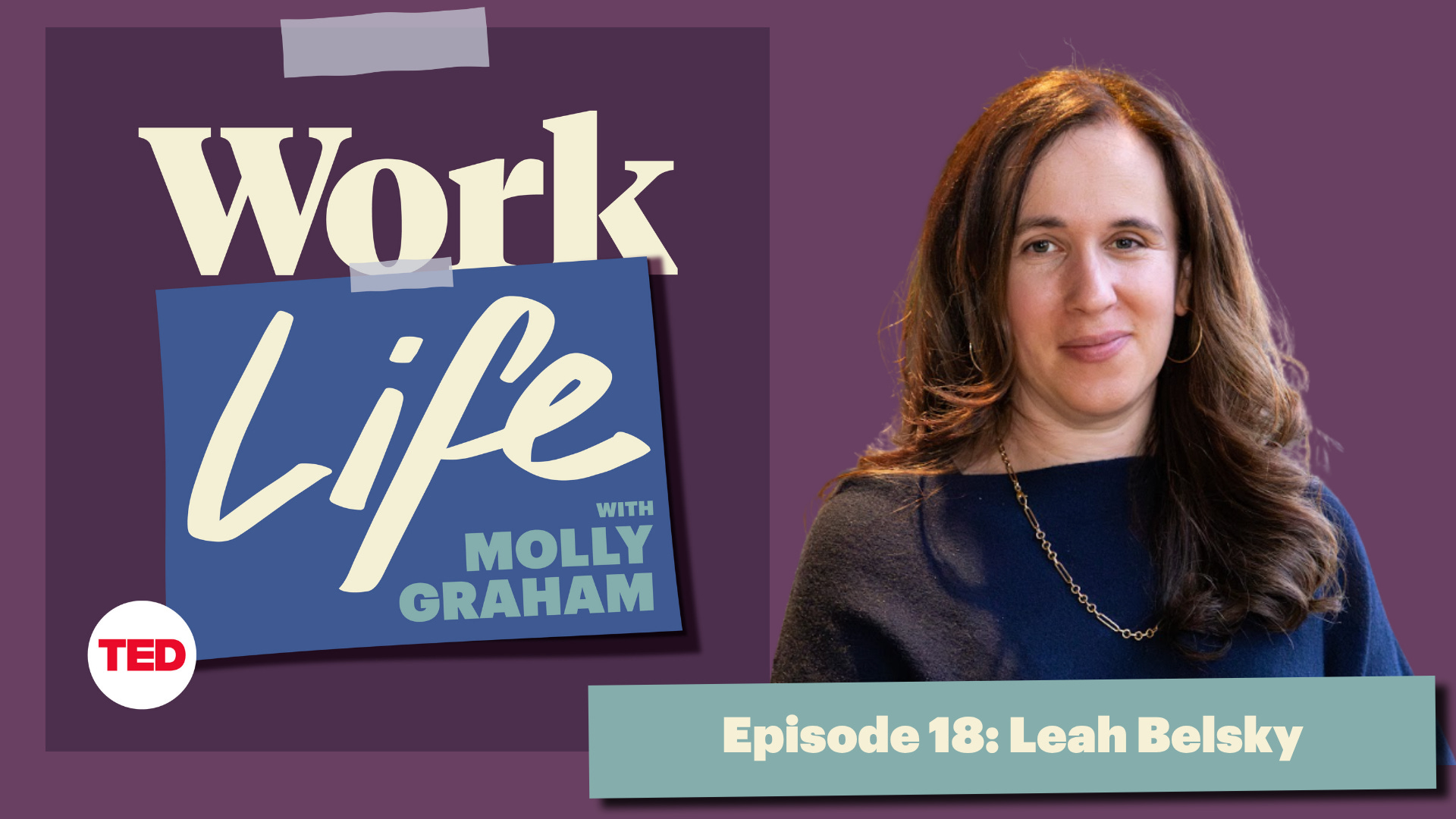
You can listen to the full WorkLife episode anywhere you get your podcasts or watch it on YouTube.
I went into this week’s episode of the WorkLife podcast from TED expecting one conversation and got a completely different one.
My guest was Leah Belsky, who has spent almost 20 years at the intersection of education and technology — she helped lead Coursera through the rise of online learning, and now she runs education at OpenAI. I figured we’d talk about AI replacing teachers, kids getting dumber, all the doom stuff you read in the headlines. That is not what happened.
Instead, we had a much more honest, much messier conversation about a question I don’t think any of us have really sat with: what is learning, actually? Not “how do we stop kids from using ChatGPT to do their homework,” but the deeper question underneath that. Because it turns out even Leah, who is as close to this technology as a person can be, doesn’t have a clean answer.
For 20 years, edtech has been chasing one dream: a personalized tutor for every kid, as good as a human one. There’s a famous study — the Bloom two-sigma study — that found kids with one-on-one tutors learn dramatically faster than kids in a classroom. That’s been the North Star of the entire industry. And when ChatGPT showed up, everyone (including Leah, at first) assumed: this is it, we finally built the tutor.
Except she told me that it’s further away than she thought. Not because the tech isn’t smart enough, but because tutoring isn’t actually about answering questions well. It’s about a human noticing you, holding you accountable, understanding your emotional state, pushing you to struggle instead of just handing you the answer. Chat can give you a beautifully personalized answer. It cannot yet make you want to learn, or sit with you while you cry over long division.
And that gap — between getting information and actually learning — is central to understanding AI’s ability to truly fill the role of tutor.
Things I’m Still Thinking About
1. Information absorption is not learning, and that difference is the whole ballgame. Leah’s daughter is dyslexic, and the first time she handed her ChatGPT’s voice mode in Iceland and watched her light up learning about the Mars Rover, it felt like a miracle — total access to the world’s knowledge, finally. But Leah was just as clear about the flip side: if her other kid takes a photo of his long-division homework and Chat solves it for him, it can feel like learning. It is not. It’s outsourcing the exact friction that builds the skill. She quoted a line from Estonia’s minister of education that I loved: there’s low-order learning (facts, recall, spitting information back) and high-order learning (reflecting, analyzing, creating) — and if we let AI do the low-order stuff for kids instead of with them, we’re not going to like what’s left. Struggling is a huge part of learning.
2. The AI tutor dream needs a human in the loop — maybe forever. I asked Leah point-blank if AI will ever fully replace a human teacher or tutor. Her answer: it’ll get a lot better, but no… because what makes a tutor work isn’t the answers — it’s the motivation, the accountability, the sense that someone actually sees you. School is really a container for exactly those things: structure, community, a reason to show up. That’s a much more useful and honest way to think about “what is school for?” in an AI world than either extreme — it’s not “school is obsolete” or “AI changes nothing,” it’s “AI can’t do the human part, so the human part is now the whole point.”
3. The real story about kids using AI isn’t about cheating — it’s about kids building things nobody gave them permission to build. Leah said the narrative everywhere is that kids are using AI to cheat. What she’s actually seeing, over and over, is kids using AI to go build solutions to real problems — without waiting for permission, funding, or a network, the way we all had to. A student using LLMs to hunt for existing drugs that could be repurposed for bipolar disorder. A high schooler building an accessible version of Wordle for her blind friend, then turning it into a company making games for kids with disabilities. A college AI club’s first project: routing unused cafeteria food to food banks. And her own 13-year-old, who went from “using Chat to survive homework” to building an entire website for the fidget-toy business he and his friends dreamed up — and came out the other side just... lit up with a sense of agency. Leah’s read, and I think she’s right, is: the skill worth teaching isn’t “how to prompt a chatbot.” It’s “how to go from noticing a problem to building a prototype.” That’s a completely different kind of education than most of us got.
I don’t think Leah left me with an answer, or that she’d claim to have one. What she left me with is a much better question — not “will AI ruin learning?” but “what do we actually want humans to be able to do in a world where intelligence is infinitely accessible?” I’m still chewing on that one, and I’m guessing I will be for a while.
Check out this sneak peek of our chat about why AI isn’t a replacement for teachers:
What else?
If this resonates with you, here are things you can do next:
Subscribe to Lessons to get new posts. I post at least 2X per month for all, and paid subscribers also get access to video courses and the full library of content.
Listen to the WorkLife podcast, where I talk to brilliant leaders and builders to untangle the messy, human side of work.
Follow me on LinkedIn, where I share more tools, thoughts, and a little of the day-to-day chaos.
And if you’re a leader looking for a community of peers to lean on and learn from, come find out more about Glue Club over here.