
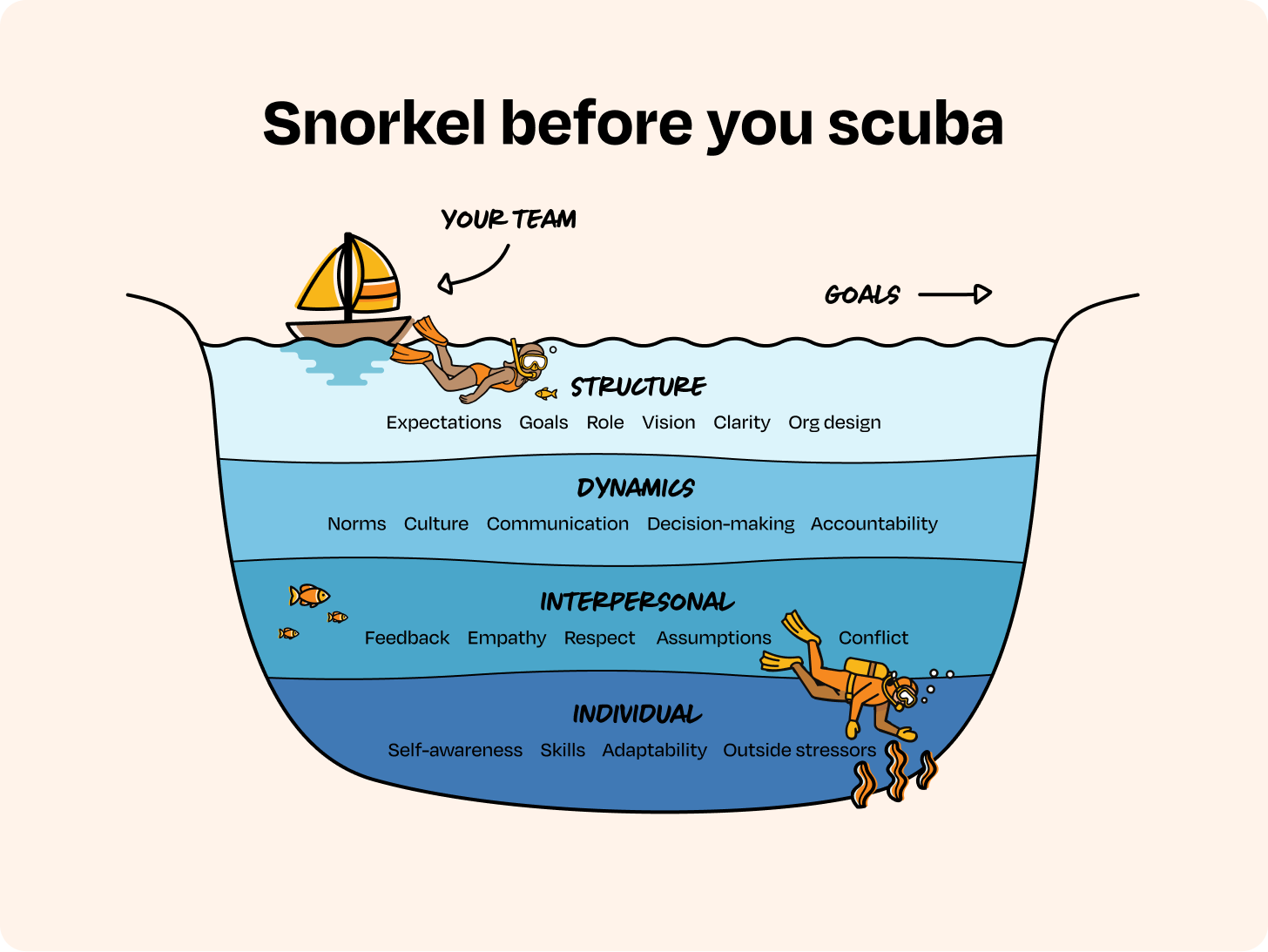
tl;dr: The Waterline Model is the topic of this week’s episode of WorkLife (Listen wherever you get your podcasts but better yet, watch the video on YouTube because we added some fun graphics this week).
If you want help diagnosing your team’s challenges using the Waterline Model, we built an awesome diagnostic tool / AI coach for you with Lovable. It uses the Waterline Model to help you think through the root cause of an issue you’re grappling with on your team and figure out what to do next.
And if you’d like to build something with Lovable, this link gives you $5 off any Lovable plan if you’re a new user!
One of the most common mistakes I see leaders make is assuming that when a team isn’t working, the problem is the people.
A team is missing its goals, decisions are taking forever, two executives can’t seem to work together, or everyone is frustrated with someone who isn’t performing. The instinct is to start diagnosing the individuals. Who isn’t good enough? Who needs coaching? Who needs to go?
Sometimes the people really are the problem. But a surprising amount of the time, the problem is actually the system you’ve put them in.
I learned a framework for thinking about this when I was leading 75-day wilderness expeditions in Alaska and Patagonia for the National Outdoor Leadership School. It’s called the Waterline Model, and I’ve been using it ever since to help debug teams at companies.
It became very popular inside Glue Club, so a few months ago, I wrote about it on Lenny’s Substack. To my surprise (and maybe even more to Lenny’s), it became one of his most popular posts – the only one in his top 10 that is not about AI. Clearly, a LOT of us are trying to figure out why our teams aren’t working as well as we’d like.
So this week, I decided to go a little deeper on the model in an episode of the WorkLife podcast. And we also made a tool to help you debug your team – a Waterline diagnostic tool that acts like a coach :) More on that below.
What is the Waterline Model?
This week’s episode of WorkLife is an expanded version of the original article. I walk through all four levels of the model, with examples of how I’ve used it to diagnose problems in real teams. The video version is particularly good this week because there’s a bunch of graphics for all you visual learners, so here it is:
If you prefer an audio version instead of video, you can listen on your prefered audio platform.
A Waterline Diagnostic Coach
Because this has been such a popular framework in all our work, we also made a tool – a Waterline diagnostic coach.
One of the hard things about frameworks is that they make perfect sense when you’re reading about them (or listening!), but then you go back to your actual job, where everything is messy and complicated, and it’s much harder to figure out how to apply them.
So we built a tool using Lovable that lets you describe a problem you’re having with your team and talk it through. It’s like a coach that can help you think about which level might be causing the problem, ask questions to test that diagnosis, and suggest possible next steps.
It won't magically solve your management problems (sorry!), but hopefully it can help you ask better questions before you start trying to fix things.
We’d LOVE to hear all forms of feedback (positive, constructive) about the tool if you try it, particularly whether it helps you see a problem differently. Feel free to comment or respond to this post.
As a reminder, if you’d like to build something yourself with Lovable, this link gives you $5 off any plan if you’re a new user!
The MollyG Holy Grail of Management
On virtually every single struggling team I’ve ever inherited, the prevailing wisdom has been that the people were underperforming and needed to be replaced. But every time, my first step is to sit down with people and perform what I now call a structural diagnostic.
As a refresher, the Structural layer of the Waterline Model is the top layer and the one that, in my experience, causes most of the problems. This is the layer you start with because it’s the things you put in place that affect everyone. Do you have a clear vision? What about clear goals? Does everyone understand their role and what they’re responsible for? Is the team structure actually designed to support what you’re asking it to do?
So to do a structural diagnostic, I go person by person on a team and ask:
Do you know what the company goals are?
Do you know why those are the goals and what the bigger vision is?
How do you think our team fits into that? What piece do we own, and what are our goals?
What is your role, and what do you think success looks like in that role?
When you ask these relatively simple questions of everyone on the team, you tend to get insane answers (particularly on underperforming teams). Sometimes people are very disconnected from the company vision and goals. Sometimes they think their job is much bigger or smaller than feels possible (or logical). But generally, you almost always find a huge amount of structural misalignment. Some of it will be patterns — everyone is confused about the goals or the vision or operating from an old version — and some of it will be individual — George has no idea what his job is.
As I annoyingly say all the time in Glue Club and our work with companies, structural clarity is the holy grail of management. If you can make sure your team has clear vision, clear goals, clear roles, and clear expectations, you are ahead of 90% of the managers out there. Most teams don’t have it. And it is hard to maintain in fast-growing companies, but if you can fight for it – set and reset, clarify and re-clarify – you typically have a high-performing team.
This is why I love the Waterline Model. It forces you to slow down and ask whether what's frustrating you is actually the cause of the problem, or just a symptom of something happening in a layer that’s higher up.
The Waterline Model has been one of the most useful tools I’ve carried with me throughout my career. It’s saved me from some pretty terrible management decisions, and it’s helped me recognize when what I needed to fix wasn’t a person, but the environment I’d created around them.
Hopefully it does the same for you.
What else?
If this resonates with you, here are things you can do next:
Listen to the WorkLife podcast, where I talk to brilliant leaders and builders to untangle the messy, human side of work.
Follow me on LinkedIn, where I share more tools, thoughts, and a little of the day-to-day chaos.
If you’re a leader looking for a community of peers to lean on and learn from, come find out more about Glue Club over here.
My team and I run keynotes and workshops inside companies to help leaders lead well through fast growth and change.
For senior women leaders looking to build empowering relationships, check out the Guild.
Molly, those four structural questions are going straight into my toolkit. Last month a staffing team asked me for more leads, and when I dug into their CRM, most of the accounts they wanted were already clients of the firm. Nobody had asked the partner down the hall for an intro. One cross-sell motion later they had fresh pipeline and spent zero dollars externally. Does your tool ever land on the people layer first?
MG! Great read as always. very much appreciate the brevity + all signal no noise nature of all your posts.
Each sentence always has a clear purpose for what its doing and why it is there. From a product perspective I like the tool a lot. Few thoughts:
- The "waterline diagnostic" header could be clickable and take you back to the home page. Otherwise, when you start a chat the only way to get back to the home screen is start over (which should take you to the start of the chat , not home imo)
- I LOVE how the visualization shifts between the stages when you move between levels. Such a nice touch.
- I asked the tool to explain the latter 2 stages when we came to a conclusion on the second, and it did so wonderfully.
- Trying to "break" the model by asking random questions gave a bounded response of "That’s outside what I cover here—I’m focused on team and workplace problems using the Waterline Model." which was great.
What an insightful and delightful way to learn. Thanks for creating nd sharing.