
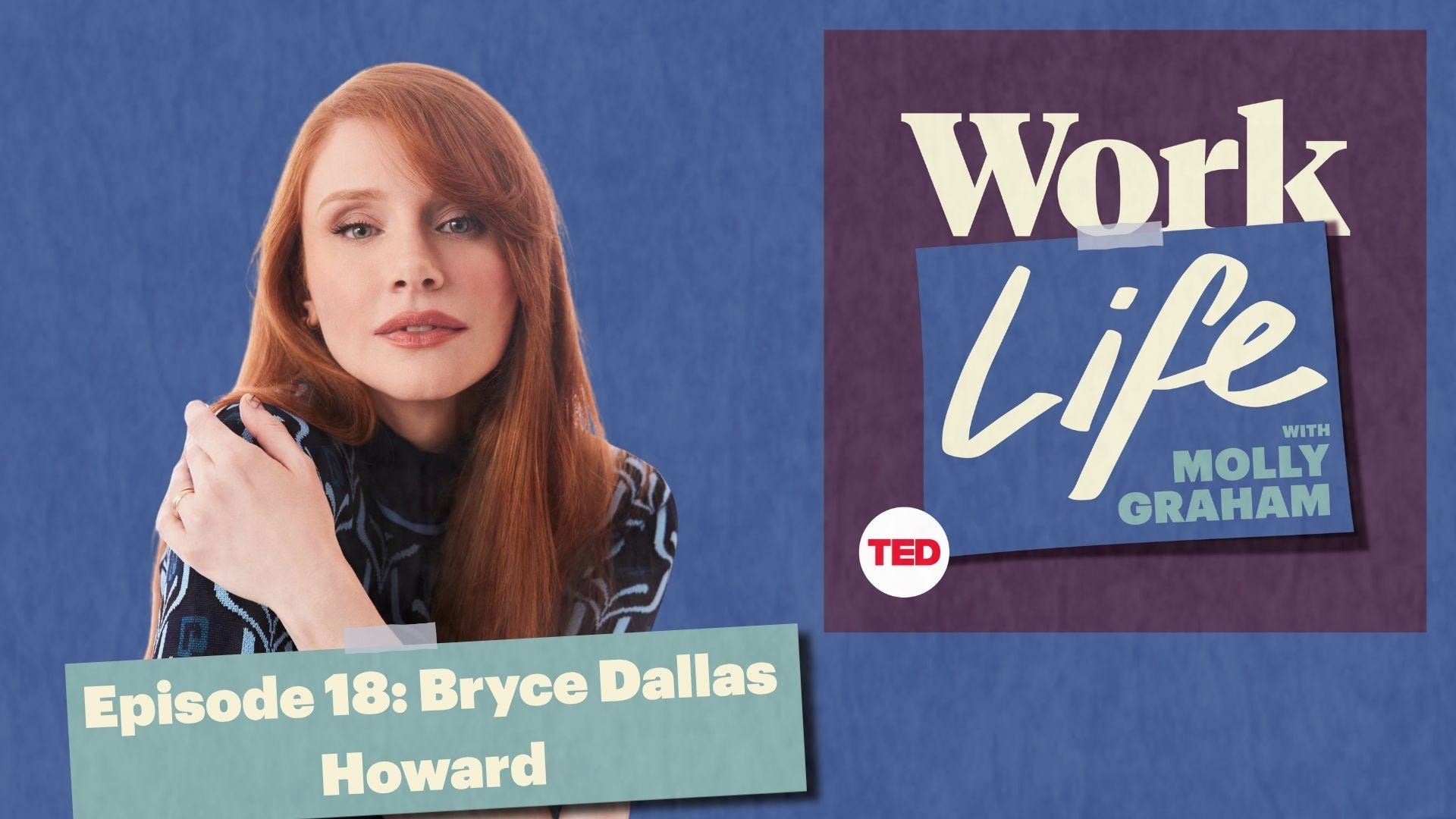
You can listen to the full WorkLife episode anywhere you get your podcasts or watch it on YouTube.
Before we started recording, Bryce Dallas Howard told me she had a bunch of stress dreams the night before about not being able to find her beta blockers. She said, “I don’t even need beta blockers for this conversation!” But I understood. I have been nervous about this episode since we decided to do it.
Bryce comes from an extremely successful, powerful family in Hollywood. Her dad is Ron Howard, one of the most famous Hollywood directors of the last 30 years. Bryce’s grandparents were also actors. She is the third generation of her family to work in Hollywood. She has her own incredibly successful career acting and directing.
This spring, when we met at the TED conference, I suggested we do an episode about coming from a successful, powerful family and how that shapes you and your career, and she said yes.
I don’t talk about my family very often, but, unsurprisingly, it has deeply shaped who I am. My grandmother was Katharine Graham. She ran The Washington Post for almost thirty years, through Watergate and the Pentagon Papers, and she was the first woman to run a Fortune 500 company. My dad, Don Graham, took over from her and ran the Post company until he sold the newspaper to Jeff Bezos in 2013.
I am incredibly proud of my family and our history. My dad is my hero and one of my main role models of what great leadership looks like.
So why don’t I talk about it much?
I also grew up with kids on the playground telling me their parents had told them to be friends with me. I have had a lot of experiences throughout my life, especially in childhood, with people assuming things about me because of my last name. And as I got older, I became increasingly determined to prove that anything I accomplished was mine.
I set out on my career journey determined to prove that I was actually good at what I did. That I hadn’t just been handed a career. That I earned it.
Bryce Dallas Howard has her own version of this.
I went into our conversation expecting that we’d compare notes about this particular experience: How do you separate yourself from where you came from? How do you figure out which parts of your success actually belong to you?
But that wasn’t how it went.
During the conversation, I told her that even now, after twenty-plus years of working, some part of me is still waiting for someone to say: You only got that because of your family.
She knew exactly what I meant. And then she basically said: What if I let that be true?
What if you accept that you didn’t earn it? Then what?
When you see the conversation in the world around Nepo Babies – a term that Bryce loves (legitimately) – you often see people who grew up with privilege trying to prove that they did it themselves.
Bryce thinks that is, respectfully, B.S. She brought up this study from UC Berkeley.
Researchers brought pairs of strangers into a lab to play Monopoly. Before they started, they flipped a coin to decide which player would be “rich.” That player got twice as much money to start, collected twice as much money when they passed Go, and got to roll two dice instead of one.
The game was obviously rigged. And, unsurprisingly, the rich players usually won.
But as the game went on, the rich players started behaving differently. They got louder. They celebrated their moves more demonstratively. They even ate more of the pretzels sitting on the table.
And when researchers asked them why they had won, they talked about their strategy and their decisions. They had literally watched a coin flip give them a huge advantage — and they still told themselves a story about why they deserved to win.
My conversation with Bryce was essentially a master class in how expansive privilege actually is and what that means.
She is very clear that she inherited wealth and security, as did I. But she also talked about inheriting confidence. She grew up watching people she loved succeed in Hollywood, so she knew that she could belong there too.
She inherited insider knowledge. Her grandmother told her, for example, that actors often audition dozens of times before landing a role, so she grew up knowing that rejection was just part of the process rather than a verdict on your talent. Imagine what a difference that makes when you’ve been rejected ten times. You don’t think, “I must be terrible at this.” You think, “This is how this works; I should keep going.”
She even talked about the privilege of growing up with parents who were happily married.
I think often about the privilege of growing up with two extraordinary examples of leadership in my family, let alone the community around them.
Her point to me was, fundamentally, “We didn’t earn it.”
But she wasn’t saying it to make either of us feel guilty. She said it because fighting that battle is a waste of time and disrespectful. Her point is that a much better question is “what am I going to do with what I was given?”
For Bryce, that means using her position to advocate for people who don’t have the same access by doing things like teaching at NYU and making sure that talented people she runs across get their work seen. She talked about the difference between mentorship and sponsorship — mentorship is sharing what you know; sponsorship is putting your name behind someone when they’re not in the room. She’s spent years doing the second one, because she has power and can use that to help other talented people rise. She’s in a position where it costs her almost nothing, and it can change someone else’s entire career.
I know Bryce and I are extreme examples. Not many people grow up with a grandmother in the history books or a father who’s a household name. Honestly, a good chunk of this episode is just me having a therapy session out loud, with a very qualified guest. (Thank you for listening to my therapy session.)
But I don’t think you need a famous last name for any of this to apply to you.
Almost everyone starts with something they didn’t earn. Maybe it’s a parent who paid for your education, or covered rent while you figured out what you wanted to do. Maybe it’s a mentor who happened to notice you early, or a first job you got because someone made a call on your behalf. Maybe it’s something less obvious — you grew up in a house where nobody raised their voice, so conflict at work has never scared you the way it scares other people. Maybe it’s your body, or your health, or the country you happened to be born in.
Whatever it is, the instinct is the same as the Monopoly players in that study: to look at the advantage and tell yourself a story about why you actually deserved to win. It’s a completely human thing to do. It’s also, mostly, a waste of energy.
You can spend your life defending your starting position, or you can spend it deciding what to do from here. Only one of those is actually in your control.
I’m so thankful Bryce was willing to open up and make space for this conversation. It taught me so much. Here’s a quick look into our conversation:
You can listen to the full WorkLife episode anywhere you get your podcasts or watch it on YouTube.
What else?
If this resonates with you, here are things you can do next:
Subscribe to Lessons to get new posts. I post at least 2X per month for all, and paid subscribers also get access to video courses and the full library of content.
Listen to the WorkLife podcast, where I talk to brilliant leaders and builders to untangle the messy, human side of work.
Follow me on LinkedIn, where I share more tools, thoughts, and a little of the day-to-day chaos.
If you’re a leader looking for a community of peers to lean on and learn from, come find out more about Glue Club over here.
One of the things I most admire about you Molly is your willingness to lead with vulnerability even (and especially) when the topics are deeply uncomfortable. This sets the stage for others to be more open and giving and leads to better dialogue and perhaps no better example than this convo with Bryce.
Some great frameworks per usual especially focusing on what you do with the privilege you've been given. But the thing that was most resonant for me was the story of your respective parents bringing you into their work (Bryce on set and you in the WaPo office) which did two things - strengthened your relationship with them and let you see their virtues in a work context. These little stories were so meaningful and makes me think about how I want to be proud enough of the work I do to bring my kids along for the ride.
A „nepo baby“ can be genuinely talented and work incredibly hard. The uncomfortable part is that talent and effort don’t erase the head start: access, networks, credibility and the freedom to fail all compound.
I wrote about this recently through the lens of whether meritocracy and nepotism can coexist — because I think the more interesting question isn’t “Did they earn it?” but “Who else might have earned it too, if they’d had the same starting conditions?”
https://sanjakyriazis.substack.com/p/can-meritocracy-and-nepotism-coexist?r=8itedk&utm_medium=ios