
Have opinions about WorkLife? We want to hear them. For the next three weeks, we’re running a survey to better understand who is listening to the podcast, and your ideas will help shape the show. The survey takes less than 5 mins! Thanks!
I’ve been thinking a lot lately about ambition. Not whether it’s good or bad — I think ambition is wonderful, and I owe a huge amount of my life and career to it. What I’ve started wondering is whether ambition has seasons.
I spent the first 20 years of my career chasing one definition of success — a big impact in a big job — and proving I could get there. Then I did… and found I didn't want it anymore. Like the thing I'd been measuring turned out not to be the thing that mattered.
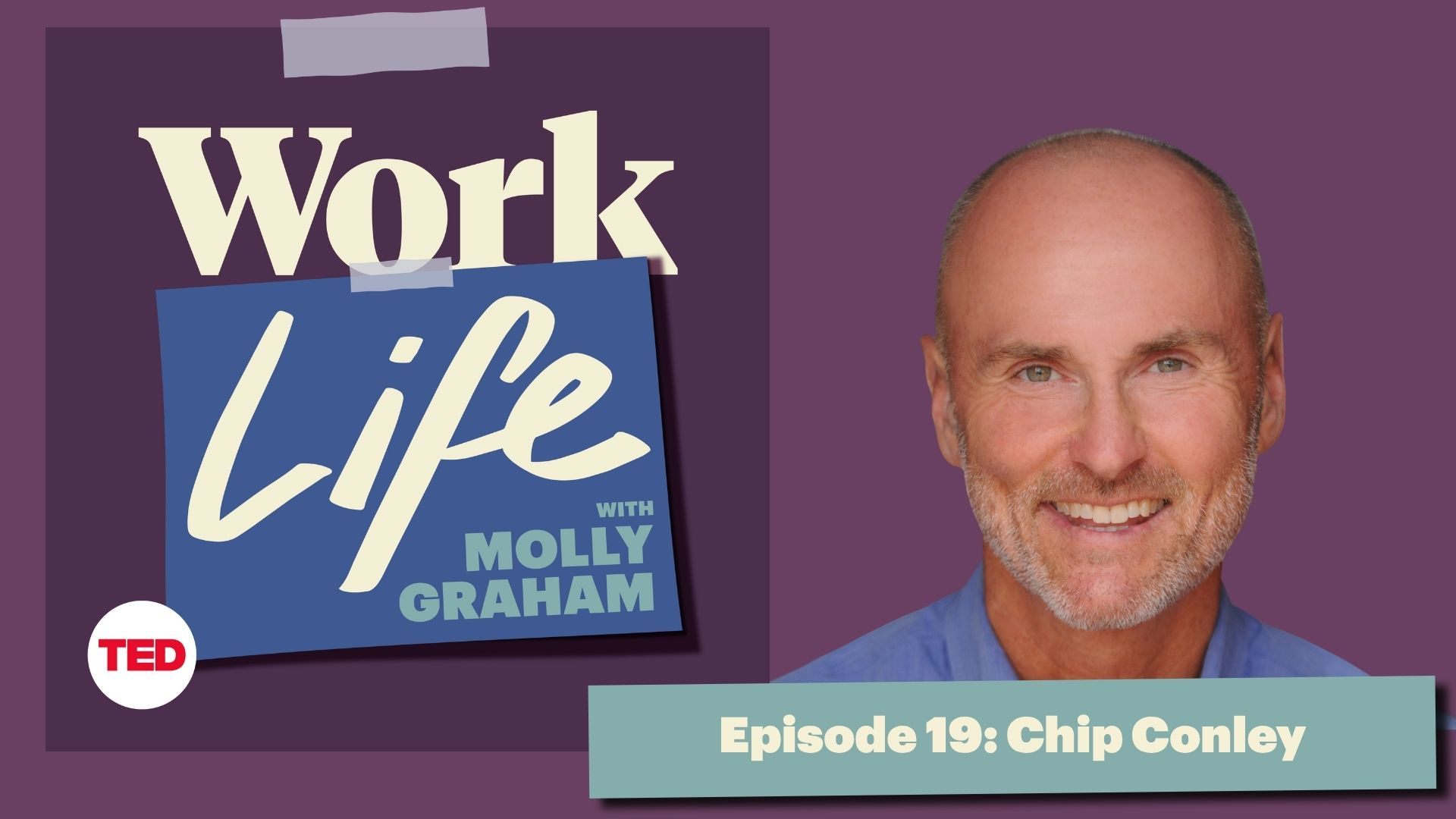
So in this week’s episode of the WorkLife podcast from TED, I sat down with Chip Conley to ask about the thing we usually call a midlife crisis. Two questions, really: Does everyone go through it? And does it have to be a crisis?
Chip is a good person to ask. He founded Joie de Vivre Hospitality at 26 and grew it to 52 boutique hotels. That business was very challenged by the financial crisis of 2008, and choosing to sell it (along with some other traumatic events, including a near-death experience) triggered his own midlife crisis. He eventually went on to become a leader and in-house mentor for many years at Airbnb, and then, because of his own experiences and learnings about the “midlife chrysalis,” as he calls it, he founded the Modern Elder Academy, where about 10,000 people from 60 countries have now come to figure out what the second half of their adult life looks like.
3 key takeaways
1. You can skip the crisis, but you can’t skip the midlife. Chip is emphatic that he would have changed his life even without his near-death experience — it just would have taken longer. The crisis is optional; the reckoning isn’t.
Something happens to almost everyone somewhere in midlife — biologically, and also because the math changes. At 40, I did the same calculation Chip did at 50: if I’m lucky and healthy into my 80s, I’m halfway. Nothing about my life changed that day except that I started to grapple with how finite time is.
Chip’s point is that you can develop transitional intelligence — his shorthand for knowing whether you’re at the end of something, in the middle of it, or at the start of what’s next, because each stage needs something different. The part most of us skip is the ending. You can’t start something new while you’re still half-attached to the thing that’s over, and we’ve built almost no way to mark that in this culture. Endings need rituals, actual ones — a wake, a fire, a friend and a list of what you’re letting go of.
2. Curiosity is a compass. Chip put words to something I couldn’t explain: how I got out of my own dark stretch. I followed my curiosity. At the beginning it didn’t feel like anything — I wasn’t curious about much, and all I could tell myself was “go try things.” Consulting engagements that drained me told me as much as the ones that didn’t.
He put it this way: talented people deserve empty space. If you have talent and curiosity, you’re good soil, and something will grow — even if you can’t name it yet.
But waiting to feel curious isn’t the same as getting curious. If nothing’s pulling at you, Chip’s question is a way to force the issue: 10 years from now, what will you regret not learning or doing today?
3. Build a purpose portfolio. Chip talked about purpose as a pie chart, and most of us let one slice take over the whole thing — for me it was work, for years, and it was genuinely enough until it wasn’t. The work of midlife is dosing down what got too dominant and dosing up what actually gives you purpose.
He got ahead of the obvious objection: this is easy to say when you’re not the one who has to make the money. His answer has two parts. First, be a responsible adult — get your obligations in order, don’t blow anything up. Second, once that’s handled, start the other thing anyway. Not for money. Just start it.
He told me about a woman who came to MEA at 60. She was a litigator, she hated litigating, but she wasn’t trying to escape — she wanted to keep working another ten years. She’d baked pies with her grandmother as a kid, so she went to pastry school and started having friends over for pastry parties. Years later, she became a bakery entrepreneur because that’s what gave her purpose.
The last thing I asked him was what living with a cancer diagnosis has taught him about work and life. He told me about the day his oncologist gave him a 22% chance of living another ten years — and then came back the next day, having run the numbers through a different model, with 80%.
“Uncertainty,” he said. “You get used to the idea that every day is a bonus.”
He also told me about his near-death experience — how, in that liminal space, he could understand bird talk. And the birds were telling him one thing: slow down.
So that’s what he’s living inside of now. Holy urgency and slow down, at the same time, every day. What he’s after, he says, is moving from the weight of the world to the wonder of the world.
Check out a bit of our conversation here:
You can listen to the full WorkLife episode anywhere you get your podcasts or watch it on YouTube.
What else?
If this resonates with you, here are things you can do next:
Subscribe to Lessons to get new posts. I post at least 2X per month for all, and paid subscribers also get access to video courses and the full library of content.
Listen to the WorkLife podcast, where I talk to brilliant leaders and builders to untangle the messy, human side of work.
Follow me on LinkedIn, where I share more tools, thoughts, and a little of the day-to-day chaos.
If you’re a leader looking for a community of peers to lean on and learn from, come find out more about Glue Club over here.
And for companies: My team and I run keynotes, workshops, and leadership cohorts that help leaders lead well through fast growth and change.
For senior women leaders looking to build empowering relationships with other women, check out the Guild.
A wonderful added resource is The Third Chapter by Sara Lawrence-Lightfoot. Sara has also written Exit -- we all emphasize beginnings but it's really important how we leave commitments.