


Choosing your next job

Apply now to join Glue Club, the home base where the strongest startup leaders in the world come together to find sanity, opportunity, and growth amidst the chaos of building a company. I pour all my mentorship and coaching energy in to Glue Club, in case you’re looking for something more than a blog post… Head over here to learn more.
There are three connected posts in this series. This one, How you know when it’s time to leave, and Taking time off. I hope they’re helpful to you!
Someone asked me to share how I think about choosing jobs and roles particularly once you’re at a point in your career when you have choice (or maybe in a job market where there’s a lot of choice).
This is an area where I’m still learning and growing (always, I think) but after many years of making my own choices and helping friends make theirs, I’ve got a set of tools that may be helpful to you.
Before I dive in, let me say two things:
1) My basic belief is that happiness at work is fundamental to high performance. Yes, I have wonderful friends who perform incredibly well in misery and anxiety, but I don’t believe it is healthy or sustainable for anyone to do that over a lifetime. In fact, I believe it takes years off of your life. I don’t know that I’m right, but it’s what I believe and it’s certainly how I manage my choices and what I optimize for.
2) It is really important to understand that making money has not been a primary motivator for me in my career (mostly because I am very lucky). That absolutely changes the equation for how you decide what to do with your time and, I think, what work means.
Tool 1: Lists and venn diagrams
I’m a huge believer that happiness AND exceptionalism (being great at what you do) in work comes from the intersection of what you love doing and what you are uniquely good at. I don’t believe that well-roundedness should be a goal. This is not a unique view nor is it something I came up with. Marcus Buckingham is one of the main pioneers of strengths-based management and he consulted with Facebook early on as we were building our talent philosophy. Spending so much time inside those philosophies early on in my career certainly left a strong impression, but at this point, I’ve coached and managed enough high performers to have seen it in action.
The trick is basically to figure out what you naturally gravitate toward and where your natural abilities lie, and then hone them to become not just good at something but exceptional at it.
I’m in the middle of my career, so what I’ve experienced so far is two big phases:
1) Learning what you are uniquely good at and what makes you happy
2) Using what you know to find the “holes that are shaped like you”
[I’m fervently hoping there’s a phase in the next 15 years called the “I don’t give a fuck” phase, but I’ll let you know when I get there...]
Alright, so phase 1:
I’m a big believer that career decisions in your 20s should be focused on learning about yourself. You learn about yourself by taking the next job that sounds fun and challenging. You learn about yourself by failing at things. You learn about yourself by taking the wrong job and having to undo it. I see too many folks early in their career striving for fancy titles, acclaim, and power without a deep understanding of who they are and what makes them tick. If you skip the “wander and see what you find” phase, you can set yourself up to do something equivalent to going to medical school and THEN deciding you don’t want to be a doctor. I’m a big fan of exploring around early and often.
The point of the exploration is to fill out these four lists:
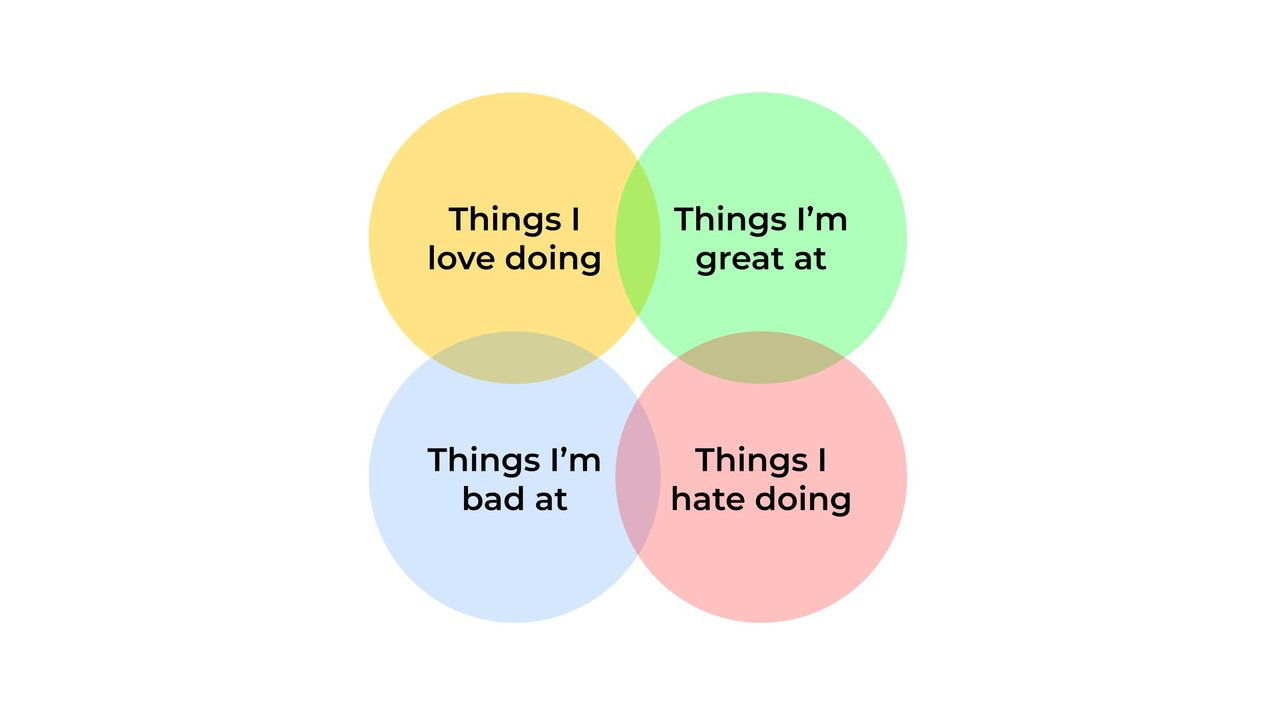
Yes, these are four distinct lists. There is definitely overlap, but there is a difference (sometimes big, sometimes small) between what you love doing and what you are uniquely good at.
The best way to fill out these lists? Reflect on your experiences as you explore different tasks, projects, and roles in order to figure out what you’ve learned.
As a manager, I try to do this regularly with my direct reports but it’s something you can easily do for yourself (with or without your manager). I do a 3- or 6-month “look back/ look forward” check in where we spend time looking back over what the person did in the last quarter and asking a series of questions like:
What was your favorite thing you did in the last 3 months?
What project or experience would you do over and over again if you could?
What things (projects, activities, etc.) made the days or hours fly by?
Were there moments when you felt at your best?
What were things that felt draining to you where the hours or days just crawled by?
What were tasks or activities that you’d be thrilled to never have to do again?
I use the answers to these questions to then look forward and try to help the person shape their next 3-6 months.
How can you do more of the things that align to you strengths and what you love doing?
What projects are coming up inside the company that might be a good fit for you or a good next challenge?
Is there a way you can do less of what drains you?
Is any of this reflection telling you that there are paths you should explore that are dramatically different than your current one?
If you do a self reflection independently, you can use the answers to shape a conversation with your manager about what might be next and how you’d like to grow.
My experience has been that you discover your strengths — the intersection of what you love doing and what you’re great at — slowly over time by reflecting on specific experiences and using them understanding where you find energy and where you feel drained.
I am now at a place in my career where I know myself quite well. I’m still learning every day, but at this point, I can get in to a lot of detail in my lists. I’ll give you some examples:
I am world class at taking huge, vague problems and breaking them down in to actionable plans and next steps. I can create order out of chaos and clarity out of ambiguity. I am good at creating something out of nothing, clarifying the goal, and bringing together a group of people to align them around where we are going. As a counterpoint, I get bored easily. I’m a restless learner who likes being on learning curves so steep that I’m scared. When things get clear or “on the rails”, I have a tendency to get bored and I’m often not the best person for the job.
I am exceptional at managing high performers. This both brings me huge amounts of joy and I think I’m really uniquely good at pushing people who are already doing well to new heights. On the flip side, I am not a great manager for people who need a lot of teaching or hand holding. I’m a sink-or-swim type manager, but if you’re a swimmer, I can often turn you in to the absolute best freestyler or butterflier or whatever that you can be.
I love Partnerships but I’m mediocre at Sales. I really love figuring out how to align the incentives of two companies, and I really enjoy building strong personal relationships to support them but as someone who loves authenticity, I’m really not great at selling products that people don’t need, and I’m terrible at closing!
I love having a product mindset in any job I’m in, but I’m a terrible product manager and a disastrous UI designer. Honestly, I’m pretty delighted if I’m partnered with someone who loves building product.
Ok, enough about me but hopefully this helps you see what I mean about the lists and getting nuanced.
Part of the reason to get nuanced in your lists is then you can shape your career around the venn diagrams.
That brings me to Phase 2 in your career:
As a very smart friend said to me once, “at some point in your career you stop looking for jobs and start looking for holes that are shaped like you.”
Happiness is going to come from finding roles that fall in the intersection of what you love doing and what you are great at. THAT is the holy grail of these lists: to be able to talk to a CEO, hear about her problems, and know exactly which ones you are perfect to solve. Equally, you want to know which problems no one should ever hire you to solve.

One of the scariest venn diagrams that shows up as you get more senior is the overlap between what you are great at and things that you hate doing. If you’re 22 and just starting out, this may seem confusing, but for those of you that are further along in your career, beware the role that sounds absolutely tailor made for you but also feels completely exhausting when you imagine doing it. Doubly beware if the job is “fancy” — where your friends and family are going to think it’s cool — because then your ego gets in the mix and wants you to take it even though your gut says that you will hate most days on that job. That venn diagram — things you’re exceptional at but hate doing — is one that can lead to career mistakes or, as I like to think of them, choices that really help you refine exactly what goes on your lists.
I don’t believe in regret generally in life; I only believe in learning. Every project or role that you experience just gives you more information about these lists and venn diagrams. My lists may be nuanced at this point, but they are still growing, shrinking, and being refined. There may be choices I’ve made that I wouldn’t make again knowing what I know now, but that’s what learning is: the chance to get to know yourself better.
[A side note for folks that are in Phase 2: I’ve found that people that know you well are always going to be the ones that find you the phase 2 roles that are “shaped like you”. People that don’t know you are always going to offer you the job you just had.]
Tool 2: The stool
At Quip, I realized that my happiness at work depends on a three-legged stool. The stool often helps me understand why I’m attracted to certain roles and not to others. The stool can also help me understand why I might be starting to feel unhappy in a certain role.
I don’t think everyone’s stool is the same. I’m not even sure they have the same number of legs. The trick for me has been to constantly deepen my understanding of what each leg of my stool is about.
The legs of MY stool are “learning”, “people”, and “mission”. I refine these definitions all the time but currently, here’s what each of those words mean to me:
People: for me, this is people I love working with and look forward to mentoring or learning from every day. The every day part is important to me -- the majority of people I work with have to fall in to this bucket. I have to be surrounded by people that inspire me either because I can learn from them or because I know I make them better. When a significant relationship at work loses this quality, it can really affect my happiness at work.
Learning: this is not just a little learning, for me, this means a learning curve so steep that I’m scared. This is the leg that means that I tend to take jobs that look nothing like my previous role. I don’t like doing things that I know how to do; I literally get energy from being on a learning curve that’s so steep that I’m terrified I’ll fail. Who knows what this says about me ¯\_(ツ)_/¯ but one of the things that has caused me to grow restless in a few of my roles and ultimately to leave was because my learning curve slowed down.
Mission: The most important question for me is: Is this a problem that makes me feel like I am making the world better in a way that matters to me? Is it a problem that I personally want to devote my time and energy toward solving? Not everyone’s mission is the same. Some people want to work on productivity software, others don’t. Some people love working on biomedical science, others don’t. There are so many important problems in the world that I’m glad people are working on solving, and only some of them are the right ones for me to invest myself in.
Sometimes I’m inexplicably attracted to a job that looks nothing like what I’ve said I want to do next, but if I think about the stool legs, usually I can figure out why the job sounds like fun. It also helps me realize why certain jobs that seem like they SHOULD be so fun just don’t sound good to me.
Relevant to my last post about how you know when it’s time to leave a job, I have realized that I can be happy at work if one of my legs is wobbly, but not two. Ideally, all the legs are strong, but one can wobble and I’ll probably still be relatively happy for a while even though I’ll know in my heart that I can’t stay forever. To be blunt: with one wobbly leg, I'm on a timeline. If two legs start to wobble, usually my happiness takes a real plunge and it's time to start asking hard questions. It is not always unfixable, but it often is.
Tool 3: The dating metaphors
So, if I’m being honest, the single best set of tools I have for helping people think through job choices comes from dating. When in doubt in your career, think about your company as a boyfriend or a girlfriend and ask yourself if your friends or family would say your relationship is healthy.
The most common example I use is the “rebound boyfriend” job. This is a HUGE watch-out for me when I’m talking to folks who are unhappy in their current role and considering a new job. People make THE WORST career decisions when they are unhappy in their current roles. They just want to get out of the relationship, but for one reason or another (usually fear, insecurity, or financial reasons), they can’t leave unless they know where they are going. The most likely outcome in these situations is that you take a job that is the opposite of your current job: you decided to date the girlfriend that is everything your current girlfriend is not. For anyone that has made this mistake in dating, these relationships usually don’t lead to happiness. Picking the opposite of what is currently making you miserable won’t lead to happiness, it just helps you get out of a bad situation.
Ok, I won’t exhaust the metaphor anymore, but the main point here is you need to be conscious of when you’re running away from something versus toward something. As an experiment, try talking about the new role you’re considering without ever mentioning any previous company or boss. Can you talk about the role with excitement without talking about what it is not? Without talking about how it’s different than your previous relationship? Are you excited about the future or running away from the past or the present?
For anyone that’s friends with me, you know that I usually strongly advise leaving your current job and THEN doing a job search as one of the healthiest ways to create separation and give yourself time to think through your next choice (unsurprisingly the same advice I’d give you about relationships), but I know not everyone can afford to do that. If you can’t afford the time off of work, then you need to figure out how to create separation while you’re still in your role OR consciously take the rebound job, but make sure you time-bound it (like a consulting agreement or a 1-year gig).
Dating provides MANY other lovely metaphors for work. For example:
The relationship that you’ve been in so long where you probably need to break up but starting over sounds terrifying
The relationship where you know you need to break up but he or she just keeps reeling you back in
The co-dependent relationship
The abusive relationship :(
I won’t bore you, but I’m sure we can make an amazing, hilarious and eye-opening list together...
We don’t often think about work or jobs as relationships, but we should. So many of the mistakes, issues, feelings or insecurities that we have in our personal lives follow us in to work. These metaphors have helped me 100 times to zoom out from a work situation (mine or someone else’s) that feels fraught and make it more recognizable and, usually, more funny.
Tool 4: Imagine your day
Last tool for now:
When we get offered jobs it’s usually easy to imagine how you’re going to feel when you take it, when you tell your parents or your friends about it, when you announce it on social media, or whatever. That’s all endorphins baby!
There are so many forces that poke and prod us when we’re thinking about whether to take the next job (see rebound boyfriend section above) from our ego to our insecurities to our ambitions, etc., so how do you sort out the good pokes and prods from the bad ones? The ones you should listen to from the ones you should ignore?
A bunch of the exercises I wrote about in the post about how you know when it’s time to leave are relevant here, but one exercise that I didn’t mention, which came from a wise friend, is imagining how a day in the job will feel. Get away from the endorphin moments and try to figure out whether you would be happy most days at work.
Close your eyes and imagine your first zoom call or going in to the office: what would the average day feel like? Do you think you’d look forward to most of your meetings? Would you be excited about and challenged by the problems? Does working with the people sound like it would mostly be fun? What feels most exciting? What do you not have enough information about?
Visualizing your average day can help you get a sense of whether the unglamorous day-to-day journey sounds genuinely exciting to you — if that’s why you’re choosing the job — or if it is some other set of forces. Beware the other forces :)
Ok, there you have it! Most of the tools I use when I’m thinking through job choices or helping friends think through them. As always, if you have questions you want me to answer, topics you want me to address, or feedback on anything, feel free to reach out.
Amazing post, Molly! I really like the Venn diagrams framework. Early in my career, I would find myself gravitating towards challenging things (good) that I did not really enjoy (bad). Over time I learned to optimize for roles doing things I love, that utilized my superpowers, with interesting, good people, focused on a common mission that matters to me. I'll be sharing this!
Fantastic post! Always a fan of new frameworks, will be adding to my toolkit.