


Developing high performers

Apply now to join Glue Club, the home base where the strongest startup leaders in the world come together to find sanity, opportunity, and growth amidst the chaos of building a company. I pour all my mentorship and coaching energy in to Glue Club, in case you’re looking for something more than a blog post… Head over here to learn more.
Most managers see high performers and just leave them alone because they are performing well. But I think high performers are where all the potential of a company lies. I try to spend the majority of my time on top performers to harness and expand their potential. When I work with them, they often end up in a role completely different from where they started — a better fit for them and the organization.
This is one of my strengths as a company builder and something I’m most proud of in my career. I measure my success by the number of people whom I have truly helped accelerate or shape their career trajectory. If you love to manage people, there’s a lot of joy in this work.
I also care about this type of work because it has been transformative to my career when people have done it for me. In a lot of ways, what is outlined in this post below is the same thing that a lot of my mentors and bosses did for me that I wrote about in this post. One of the first ones was Chamath, who saw me run a project on Facebook’s HR team as an individual contributor in my early twenties (the project was to define Facebook’s company values). He noticed some of my strengths and put the opportunity for some cool new roles in front of me. I ended up leading a project to build a mobile phone, and that put me on a whole new path – one that eventually led me to be a leader and operator at a series of startups.
I call that kind of role switch a J Curve. J Curves are stretch opportunities where you take on a role outside your comfort zone. In the best case, these roles make you feel like you’re on a whole different planet. They’re high risk, but if you succeed, they accelerate your growth like nothing else can.
These opportunities can be transformative for someone’s career trajectory but they are also very powerful for the company. They take someone with high potential and accelerate it. And if done well, they align your highest performers with your biggest priorities.
There’s nothing more magical than watching someone do things they didn’t know they were capable of. And it feels great to give the company an amazing new leader. You can nurture high performers from anywhere in the company — sometimes, the people I develop don’t report to me. And sometimes they’re external talent I recruit from a totally different industry.
From a company perspective, you have to do this if you want to retain high performers. If you’re not offering them exciting opportunities that scare them, they will get bored and leave.
I’m a strong believer in earned opportunities for people who do good work, so when a highly visible role opens up (e.g., chief of staff), it’s a great time to look internally for a high performer. Give these folks the first bite of the apple.
If a company is struggling financially, this is even more important. People’s personal growth path can often have a more powerful retention effect than the company’s success; people will stay if they feel challenged and valued enough. While often you can’t really control whether a company goes bankrupt or goes public, you CAN create customized growth plans for individuals by putting J Curves in front of them and providing support.
Some real-life examples
At one company, I noticed a young woman who was crushing some research projects and felt that she could be working on more mission-critical things. I identified her as a strong project manager by talking to her and watching her work. Then I gave her a series of test projects for central operational systems, like running performance reviews. We’d meet at the end of each project to debrief and I’d update my mental sketch of her skills. She went on to become an important “operator” inside the company — someone who helped run things like annual planning, all hands, etc.
I once met someone who impressed me with her amazing organization for an event I was part of. I thought she might make an amazing project manager or operations person, so I recruited her as an EA and she eventually ran all operations for one of the startups I was part of.
My team worked above a coffee shop and built a strong relationship with the manager of that store because we were there every day. We realized he had exceptional customer relationship skills, and eventually, we hired him to lead customer support for our startup.
When I started as COO in one of my jobs, I noticed that another senior exec was naturally dabbling in operations projects like goal setting because he enjoyed it. He was actually managing a very narrow part of the team but he quickly showed that he was very very talented at things like metrics and business operations. He didn’t think of himself as an operator and didn’t know he was good at it, but over time, through a series of tests and projects, we both realized he could basically do my job. I slowly had him lead projects in more central parts of the business and eventually take over bigger and bigger parts of the team.
Identifying a high-performer
The process begins when someone impresses me — they ship something that’s better than expected or crush a presentation. Maybe their name comes up a lot in some set of discussions or a perf cycle’s calibration.
Then I ask others for context on the person to understand their broader performance — usually, I start by asking people on the leadership team but sometimes other managers or other high performers. I gather data on what the person has been good at and what’s holding them back. This gives me a sense of whether other people see their potential as well.
Once I’ve gone through these steps, I’ve sort of verified that this person is worth investing time in. My goal is to (a) get to know them better, (b) build the foundation of a coaching relationship with them, and (c) find ways to give them J Curve opportunities.
I basically build a hypothesis about what someone’s good at and then I test that hypothesis. I talk to them, ask them questions, and get them to share stories and experiences with me. Then I give them opportunities and see how they go.
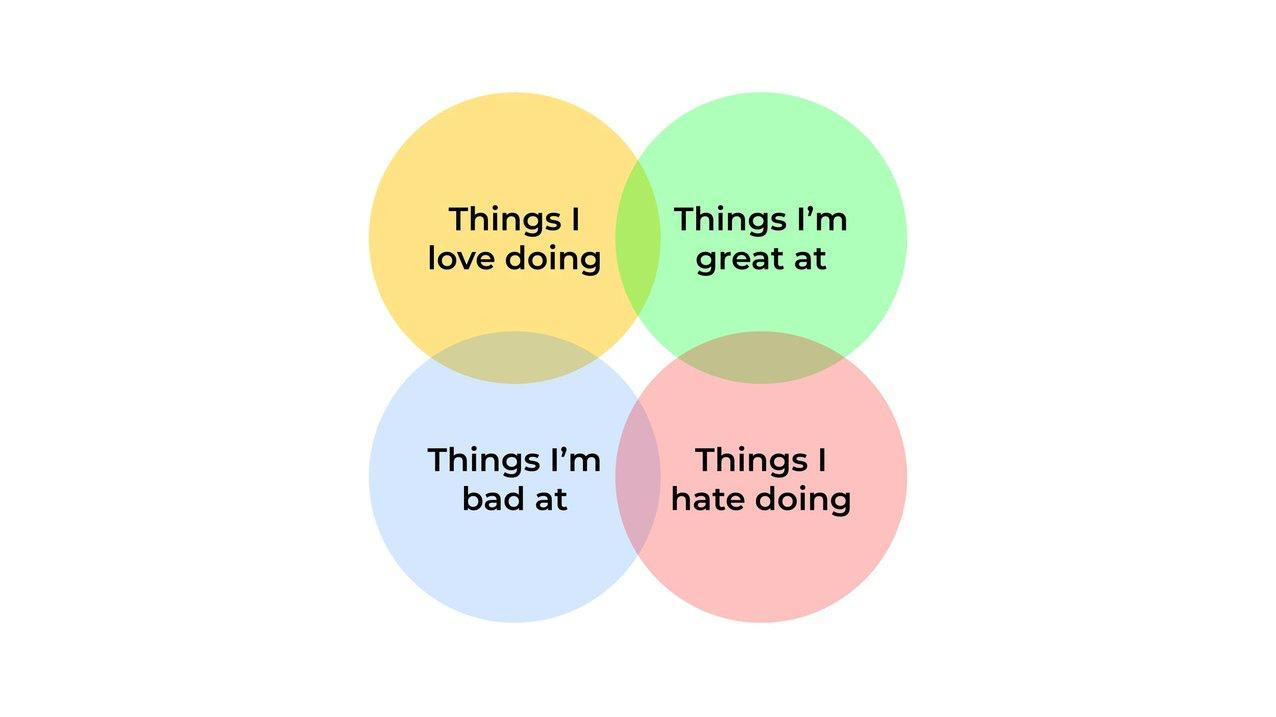
Part of what I do with them is help them fill out their four lists: what they say they’re good at, what they’re bad at, what they love doing, and what they hate doing. This exercise helps them with self-discovery and helps me figure out what opportunities to put in front of them.
Finding the right J Curve through a series of test projects
Sometimes, I find a high performer and immediately match them with a J Curve role. This can happen when we do an internal search for a job opening. They dive in, and I start coaching them.
Other times, I take a while to get to know the person and find the ideal J Curve. In these cases, I use cycles of test projects and debriefs to learn more about them.
I look at their natural strengths (intersection between the list of what they love, and the list of what they’re great at). Then I ask, where’s the company missing an employee with this skill?
I bring the high performer a few project options to choose from. This is another part of the process that helps you learn who they are. It can reveal what they’re naturally excited about as well as their risk tolerance. At Facebook, when I was offered the phone project that I talked about in the J Curve post, Chamath actually brought me three choices — work with him on the mobile phone, work on the international growth team, or work on one of his other teams. He also said I could stay in HR but he thought that was a bad idea :) Sometimes the options that you offer are iterations like “stay doing what you’re doing, just bigger” but sometimes they are “go do this very different thing.” Watching what they are naturally interested in and what they ultimately choose gives both you and them information about their “what I love doing” list.
Once they pick a project, I watch how well they run it, and how independently.
After a project or key milestone is over, we debrief with questions like:
What they liked about the project
What the most difficult parts were
What mistakes they made
If they could do this again, would they?
Could they do it with more independence next time?
This data collection helps me find the next challenge. Debriefs should happen on a cadence that gives you a fast iteration cycle. For a short project, debrief as soon as it’s over. For a long one, you can debrief at regular intervals or at significant milestones. Quarterly debriefs can be helpful too.
That’s the cycle. It’s about making a sketch about who someone could become, testing your hypothesis with a project, evaluating how it went, and running the next test.
The process of developing leaders is gradual. If you want to shift someone into a different area of the business, but you’re not ready to move a large initiative under them or you don’t want to step on any toes, give them ownership of small projects that fall through the cracks of other people’s jobs.
This lets you prove out your hypothesis and helps them build authority until it’s obvious they should be running more stuff and the opportunity arises for something bigger.
Coaching and feedback
In my personal experience, managers like Chamath did more of a "throw you off the cliff and see if you swim" method of giving me J Curve opportunities. There was not a lot of coaching or feedback after I started in the new role. And that is a valid approach. It worked fine for me, but there were a lot of bumps and bruises along the way. I think other people paid the price for the fact that I was not that closely coached, so I believe actively mentoring folks through this process will help them be more effective more quickly.
Almost every high performer that I have worked with is hungry for feedback, but they rarely get enough of it. As I said, most managers leave high performers alone. I see them as balls of untapped potential. I try to build a really strong partnership where they actually come to me asking for feedback and help solving problems.
Early on, I’ll make sure that we have a 1:1 convo that sets the foundation for a coaching relationship. Most of the people I develop in this way are folks I can be really direct with. In that foundational conversation, I focus on sharing what I’m observing and hearing about them: that people are impressed with A, B, and C, and together we can improve X, Y, and Z. I make it clear that I’m excited about their potential and want to help them.
And honestly, what I do from there with feedback is not that sophisticated. It’s just frequent.
Basically, every time they do something significant, I tell them if they knocked it out of the park or if there’s something they can try next time (or often both). I build on the themes from that initial foundational conversation. I also like to focus on anything they need to know as they get more senior — like how to communicate with the CEO effectively, how to lead effective meetings, how to influence peers, how to coach and mentor their own teams, etc. These are skills that matter when you go from being an IC to a leader and often cause bumps and bruises if people go through that transition quickly (example: me).
Sometimes I’ll line up additional sources of coaching. This is especially helpful if you put a junior person in charge of something that feels too big for them. At one of my companies, we took an IC and made her the owner of a key branch of the company. We paired her with a senior, external consultant who spent 5-10 hours per week with her and her team. It let us all (her and our leadership team) feel more confident as she transitioned from IC to leader. It gave her an “on the ground” coach and confidant and it gave me someone who I could trust to tell me how things were going. It was so fun to watch her grow and develop, and she went on to run a lot of different big strategic projects.
“I dare you to fail”
For people to take J Curve risks and be willing to jump off the cliff with you, they need to know that you’re gonna catch them if they fall. It’s important to set them up mentally to understand that their main job is not to be perfect but to learn as fast as they can. And that comes with mistakes. If they fail, they need to know that they still have a job and you’ll still think well of them. Because many high performers are used to being perfect or exceptional at their jobs, I often use the phrase “I dare you to…” followed by “fail” or “make a mistake” or “prove me wrong” to help them see that taking risks, struggling, making mistakes, etc., is an expected part of this journey. A J Curve is never going to feel comfortable — but at least you can make it feel a little more safe.
Look at you being a better boss then I've ever had or were.
A tactic I like to pursue in this course is to find the intersection between a high performer's interests and unrecognized needs in the organization. Most companies are sufficiently dysfunctional that you can give this effort to a high performer without impacting delivery schedules. Then they have something they can engage with and own.