
Part 4: Compensation for startups: A performance review system for startups

👋Hi! I'm Molly. This is where I share the lessons I’ve learned from building fast-moving, messy, ambitious companies. For more from me, you can also find me on the WorkLife Podcast, on LinkedIn, and in Glue Club, a community for leaders who care about building great companies.
This article is part of a series on compensation for startups. It covers implementing a leveling system. The four parts are:
If you are actively designing and implementing any of these systems, we also have video courses and dozens of templates available for paid subscribers.
For early-stage startups, there’s this constant tension between too much process and too little process. Performance review cycles are especially tricky because they’re a huge time suck for the whole company. All employees direct their attention to writing peer reviews at the same time, 1–2 times per year — it’s like a giant black hole for everyone’s energy.
My friend at Facebook who worked in IT once told me they measured the whole org’s productivity (emails sent, tasks closed, etc.) during the annual performance cycle. This was when the company had about 40,000 employees. They found that even though people could technically work on other things during those weeks, productivity dropped to near 0%.
Founders often ask me if perf cycles are valuable enough for this sacrifice. They wonder whether they should have a system for ongoing feedback instead, so people don’t get feedback just twice per year.
After designing or running perf at dozens of companies, from 5 to 5,000 employees, I’ve come to believe that, yes, perf cycles are an amazing use of company time — if you are ruthless about keeping them short.
Don’t get me wrong, you should definitely give feedback year-round. That’s great. But perf cycles are about so much more than that — especially if you pair all compensation changes with your perf cycle timing. Proper perf cycles force you to look at the whole company 1–2x per year to make sure you’re (1) consistent about things like expectations for employees and the definition of high performance, (2) compensating employees based on the same standards, (3) rewarding high performers, and (4) using your payroll budget wisely (one of the largest company expenses you’ll have). Doing these cycles lets you condense those efforts into a few pre-scheduled weeks so everyone can focus on other things the rest of the year.
In this post, I’ll share my performance review system, which aims to minimize the energy drain while getting those benefits. I’ll outline the steps, tools, and timelines that you’ll need to set up peer review cycles, calibrate reviews, and calculate salary/equity raises.
There are one million debates about the right way to do perf, but most startups need to focus on the basics. My system is a simplified version of Facebook’s and Google’s, which frankly means it’s “old school.” But it will get the job done and scale for a long time — up to thousands of employees. If you’re a small startup, I recommend rolling this system out by the time you have 50 employees.
Perf system in the broader context
This perf system goes hand-in-hand with two other systems: leveling and compensation. These three systems work together to let you pay for performance, which is something I deeply believe in. The results of a perf cycle drive an employee’s salary raises, title/level growth, and other compensation changes.
Before setting up perf, you’ll want to set up the other systems.
Design your leveling system.
Design your compensation philosophy.
And then rollout your compensation system in tandem with this performance cycle.
Many HR leaders don’t believe in performance ratings, but for pay-for-performance to work, you need them — and you need them to be numerical so you can plug them into compensation formulas. This helps you be consistent across departments when you make comp and level changes.
In my system, each perf cycle produces two numerical outputs for every employee:
a performance rating — a number
a promotion decision — a binary Yes/No
Those two outputs go into a compensation spreadsheet, and it spits out salary and equity multipliers for each employee. That’s the basis of the formulaic compensation model.
Core principles of my perf design
These are my strongly held beliefs that guide the design of this performance review system:
Who: Everyone all at once
For fairness and consistency, I review the whole company at the same time, not in separate groups. I’ve seen systems based on start date — you get a review on your 1-year anniversary — but this introduces bias and a bunch of complexity. Rolling systems tend to mean that different standards are applied to different people as circumstances change month to month.
Execution Speed: Fast
This process can go on forever if you let it. Get it done (painfully fast) and move on.
How: Comp and perf at the same time
To tie performance to compensation, you need them to happen in the same time period.
How often: Twice a year
Once per year is too infrequent for how fast our industry moves, but quarterly is overkill. I do a heavy cycle and a light cycle, as outlined below.
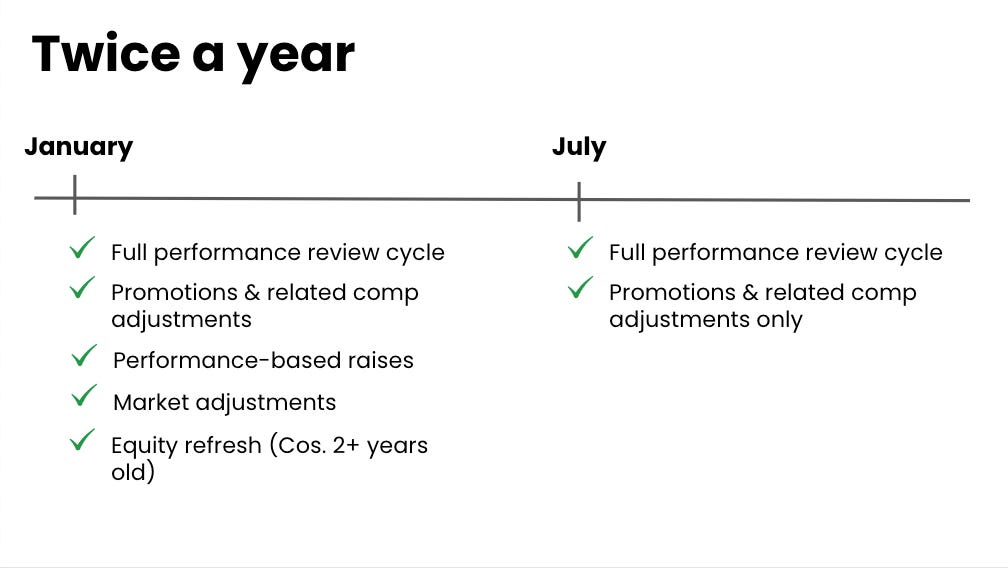
Here’s what my typical 2x per year perf schedule looks like. In January, I do a full performance review and an all-company compensation review. In June & July, I do another full performance cycle, and comp changes, but only for promotions and tenure-related adjustments. But you can decide on the months that work for you.
Without further ado, let’s get into designing and rolling out your perf system.
This article has two parts:
A) How to prepare (aka what you need before you start)
B) The 5 steps of the performance process
